❤️ A gift to Libya: This website is offered freely as a donation to showcase Libya to the world — in the spirit of hope, welcome, and a shared future.
From the golden sands of the Sahara to the azure shores of the Mediterranean — Libya opens its doors to the world with ancient heritage, warm hospitality, and a future full of promise.
About Libya
Libya — officially the State of Libya — is a country of remarkable contrasts: the vast silence of the Sahara, the vivid blue of the Mediterranean, millennia of civilisations layered upon one another, and a people renowned for their generosity and warmth.
Libya is one of Africa's largest countries by area, stretching across the northeastern Sahara. Its 1,770-kilometre Mediterranean coastline has made it a crossroads of civilisations — Phoenician, Greek, Roman, Byzantine, Arab, Ottoman — each leaving a mark in stone, language, and tradition. Today Libya holds four UNESCO World Heritage Sites: Leptis Magna, Sabratha, Cyrene, and the Old Town of Ghadames.
Libya is divided into three historic regions: Tripolitania in the northwest — the cultural and commercial heartland; Cyrenaica in the northeast — ancient seat of Greek learning and the Sanusi heritage; and the Fezzan in the south — a world of oasis towns, Tuareg culture, and prehistoric rock art that speaks of a time when the Sahara was green. All three regions welcome visitors with distinctive flavour and pride.
Home to some of the best-preserved Roman, Greek, and Phoenician sites anywhere in the world — more Roman ruins survive in Libya than in Italy itself.
From the Akakus Mountains' ancient rock art to the crystal-clear Mediterranean bays, and the sweeping erg dunes of the Fezzan — Libya's landscapes are breathtaking.
Libyan hospitality — al-karam — is a cherished cultural value. A visitor is a guest of honour; sharing food, tea, and story is at the heart of Libyan life.
The Land of Libya
Stretching 1,759,540 km² across North Africa — Libya is the 4th-largest country in Africa. From the Mediterranean coast to the heart of the Sahara, its landscapes are as vast as its history is deep.
1,759,540 km²
4th-largest country in Africa · 17th-largest in the world
1,770 km
Longest Mediterranean coastline in Africa — pristine bays, ancient harbours, crystal-clear waters
Tripolitania (northwest) — Phoenician and Roman heritage, Mediterranean coast
Cyrenaica (northeast) — Ancient Greek cities, Green Mountain
Fezzan (south) — Saharan landscapes, Tuareg culture, prehistoric rock art
Tunisia · Algeria · Niger · Chad · Sudan · Egypt
Libya sits at the heart of North Africa — a crossroads of the Mediterranean and Saharan worlds
5 UNESCO World Heritage Sites — more than most countries in the world:
Leptis Magna · Sabratha · Cyrene · Old Town of Ghadames · Tadrart Acacus (Akakus)
The Land of Libya
Stretching 1,759,540 km² across North Africa — Libya is the 4th-largest country in Africa. From the Mediterranean coast to the heart of the Sahara, its landscapes are as vast as its history is deep.
1,759,540 km²
4th-largest in Africa · 17th in the world
1,770 km
Africa's longest Mediterranean coast — pristine bays, ancient harbours
Tripolitania — Northwest · Roman & Phoenician cities, Mediterranean coast
Cyrenaica — Northeast · Ancient Greek cities, Green Mountain plateau
Fezzan — South · Saharan landscapes, Tuareg heritage, prehistoric art
5 Sites
Leptis Magna · Sabratha · Cyrene · Old Ghadames · Tadrart Acacus
Tunisia · Algeria · Niger · Chad · Sudan · Egypt
A crossroads of the Mediterranean and Saharan worlds
Cities & Heritage Sites
Each city carries the memory of a different civilisation. Together they form one of the richest archaeological landscapes on earth.

Founded by the Phoenicians, embellished by the Romans, adorned by the Ottomans — Tripoli's ancient medina, the Arch of Marcus Aurelius, the Red Castle Museum and its vibrant souks make it a city of extraordinary layers. The waterfront Corniche offers sweeping Mediterranean views.

Birthplace of Emperor Septimius Severus and arguably the finest Roman city in the world — its amphitheatre, basilica, and monumental arch stand largely intact after two millennia, preserved by the Saharan sands.

The "Pearl of the Desert" — an ancient Berber oasis town whose white-plastered architecture, interconnected rooftop walkways, and cool covered streets represent the pinnacle of pre-Saharan urban design. Continuously inhabited for over 10,000 years.
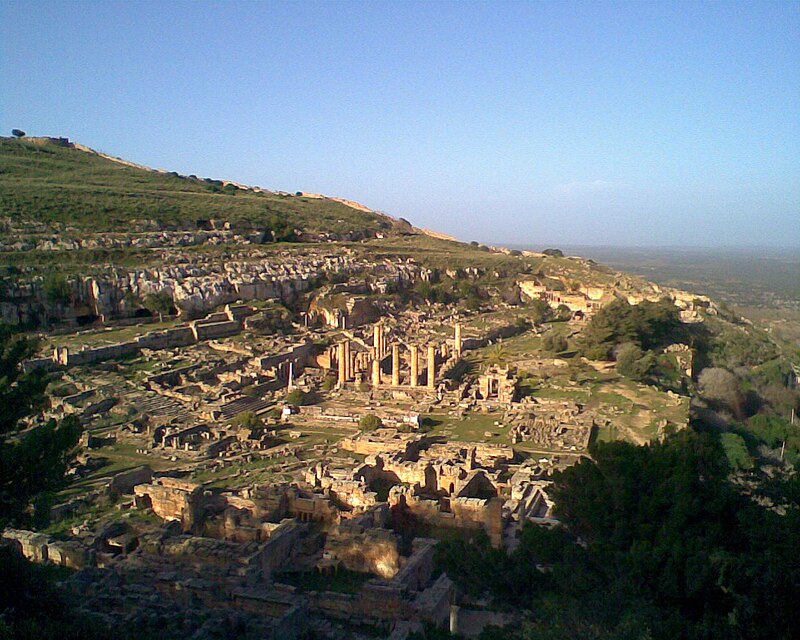
Founded in 631 BCE as a Greek colony — its temples of Apollo and Zeus, the Sanctuary of Demeter, and its celebrated medical school made Cyrene one of the great intellectual centres of the ancient Mediterranean.

A vast gallery of prehistoric art — over 12,000 years of rock paintings and engravings depicting animals, humans and landscapes from the time when the Sahara was a fertile savannah. The sculpted sandstone formations are a wonder in themselves.

A Phoenician trading post turned Roman showpiece — Sabratha's theatre, with its ornate three-storey stage backdrop, is one of the most beautiful structures of the ancient world, still used occasionally for cultural performances.

Libya's second city and the capital of Cyrenaica — a proud Mediterranean port with Greek and Roman heritage, renowned for its traditional Libyan architecture, the Fountains Square, and a vibrant commercial and cultural life.

Known as the "Bride of the Mediterranean" — Misrata is renowned for its centuries-old weaving tradition producing exquisite silk and wool textiles, its active port, and the historic Souq Al-Tlat bazaar.

The Green Mountain — a cool, forested plateau near ancient Cyrene with unique Mediterranean flora, scenic valleys, and a refreshing climate that contrasts dramatically with the Saharan south.

Home to the revered Sidi Abdul Salam Al-Asmar mosque — one of North Africa's most significant Islamic pilgrimage sites — and celebrated for its traditional Islamic architecture and coastal beauty.

Gateway to the Fezzan — a meeting point of trans-Saharan trade routes for millennia, where Tuareg, Tebu, and Arab cultures converge around ancient wells, mud-brick fortresses and the sweeping Ubari Sand Sea.
One of Libya's most scenic coastal cities — nestled between the Mediterranean and a dramatic gorge (wadi), with Ottoman architecture, a natural freshwater spring flowing to the sea, and a literary tradition that produced some of Libya's finest poets.
A Journey Through Time
Libya's soil has been walked by Berber peoples, Greek philosophers, Roman emperors, Arab scholars, and Ottoman governors — each era gifting a layer of heritage to the world.
When the Sahara was a fertile savannah with rivers and lakes, Neolithic peoples painted extraordinary scenes of hippos, elephants, cattle, and human ceremonies on the rock walls of the Akakus — a record of a lost world of abundance.
Phoenician seafarers established trading posts along the coast — Oea (Tripoli), Leptis Magna and Sabratha — forming the "Tripolis" (Three Cities) that gave Tripolitania its name. These became vibrant hubs of Mediterranean commerce.
Greek colonists from Thera founded Cyrene, which grew into one of the ancient world's great cities — producing the philosopher Aristippus, the physician Eratosthenes (who first calculated the Earth's circumference), and the poet Callimachus. The Pentapolis — five great Greek cities — flourished across Cyrenaica.
Under Roman rule Libya became one of the empire's wealthiest provinces — its wheat fed Rome, its olive oil lit the Mediterranean world. The Emperor Septimius Severus, born in Leptis Magna in 145 CE, lavished his hometown with spectacular monuments. Leptis, Sabratha, and Cyrene became cities of marble and grandeur.
Arab Muslim armies arrived in 647 CE, bringing Islam and the Arabic language — both of which became central to Libyan identity. Over subsequent centuries, Libya was governed by successive Islamic dynasties: the Umayyads, Abbasids, Fatimids, Hafsids and others — each contributing to the great mosques, madrasas and sufi lodges that grace the old cities.
Libya became an Ottoman province — the Karamanli dynasty ruling semi-independently through the 18th and early 19th centuries. Tripoli flourished as a trade crossroads and corsair port. Ottoman architecture — mosques, hammams, the Red Castle — shaped the character of the coastal cities.
The Libyan people mounted one of Africa's most sustained anti-colonial resistances. The legendary Omar Mukhtar — teacher, scholar and guerrilla commander — led resistance in Cyrenaica for over twenty years until his capture and execution in 1931. He remains a beloved national hero and symbol of Libyan dignity.
Libya became the first country in history to achieve independence through a United Nations resolution. On 24 December 1951, King Idris I proclaimed an independent, united Libya — the first new sovereign state on the African continent in the modern era.
Under King Idris I, the newly independent nation established its institutions and, following major oil discoveries in 1959, began transforming its economy. Libya's oil wealth brought rapid development of infrastructure, education and healthcare — though political power remained concentrated and regional inequalities persisted.
Following a bloodless coup in September 1969, Colonel Muammar Gaddafi governed Libya for over four decades. Oil revenues funded free education, healthcare and subsidised housing, and Libya achieved some of the highest human development indicators in Africa. However, political opposition was suppressed, civil institutions were dismantled, and the personalised system of governance left the country without the foundations needed for stable governance. International isolation — including UN sanctions in the 1990s — limited Libya's economic development before partial reintegration in the 2000s.
In February 2011, popular uprisings inspired by the broader Arab Spring swept across Libya. Months of civil conflict, supported by a NATO-led international military intervention under a UN Security Council mandate, ended Gaddafi's government in August 2011. The revolution brought enormous hope and opened a new chapter — though the transition to stable governance proved deeply challenging.
Libya is a nation of extraordinary resilience and immense potential — blessed with ancient heritage, vast natural resources, a young and educated population, and a people of legendary warmth and generosity. The path to lasting stability and shared prosperity has been difficult, and Libyans continue to work toward reconciliation, democratic governance, and the reconstruction of their country. Libya is changing. Libya is trying. The world is welcome to witness and join this journey.
Natural Wonders
Libya's landscapes range from one of the world's largest deserts to a pristine Mediterranean coastline — offering experiences found nowhere else on earth.
Vast erg dunes, ancient volcanic massifs, silent oasis towns and a sky full of stars — the Libyan Sahara is one of the last great wilderness experiences on earth. The Ubari Lakes — turquoise waters nestled among dunes — are among the desert's most ethereal surprises.

Libya's 1,770-kilometre Mediterranean coast is one of the longest in Africa — ancient harbours, crystalline bays, and pristine beaches largely undisturbed and waiting to be discovered. The Gulf of Sirte and the eastern coast near Derna are outstanding for their clarity and beauty.

The sculpted sandstone arches and towers of the Akakus Mountains — alongside the Ubari Sand Sea with its mirror lakes — form a landscape of otherworldly grandeur, protected as a UNESCO site and beloved by explorers and artists alike.
The Green Mountain plateau in Cyrenaica surprises visitors with fragrant cypress, juniper and oak forests — a cool highland landscape with ancient Greek ruins emerging from the greenery, utterly unlike the desert image many hold of Libya.

From Ghadames in the west to Al-Kufra in the east — Libya's ancient oasis towns are places of extraordinary beauty: date palms, sweet water, the sound of wind through palm fronds, and traditions stretching back thousands of years.
Libya's coasts host loggerhead sea turtle nesting sites, rich marine biodiversity, and flamingos in the coastal lagoons. The Saharan south is home to Fennec foxes, desert monitor lizards, and migratory birds on ancient flight paths.
Traditions & Culture
Libya's three historic regions — Tripolitania, Cyrenaica, and the Fezzan — each preserve distinctive traditions shaped by geography, history, and the heritage of many peoples: Arab, Berber, Tuareg, Tebu, Greek, Ottoman, and more.
Atay (mint tea) is served in three small glasses — first bitter, then balanced, then sweet — symbolising the stages of life. Declining tea from a host is considered impolite; accepting is a gesture of friendship.
Food is traditionally eaten together from a shared central dish. The right hand is used; a guest is always served the finest pieces. Refusing food may cause offence — a small taste is a sign of respect.
Greetings in Libya are warm and extended — Assalamu alaikum (Peace be upon you) is met with Wa alaikum assalam. Elders are greeted first; handshakes with the right hand are customary.
Libya is a Muslim-majority country. Visitors are warmly welcomed but are asked to dress modestly — covering shoulders and knees in public spaces, particularly in traditional towns and near religious sites.
During Ramadan, daily life shifts to evening celebrations — the iftar meal (breaking the fast) is a communal and joyous occasion. Eid Al-Fitr and Eid Al-Adha are celebrated with new clothes, family visits, and gifts.
Libyan weddings are multi-day celebrations with separate events for men and women, traditional music, henna nights, and spectacular feasts. The zaffa (procession) is a moment of great pageantry and joy.
Sufi brotherhoods across Libya maintain living traditions of spiritual music and poetry — the Qadiriyya, Tijaniyya and Sanusiyya orders each have their own distinctive musical traditions performed at their lodges.
In Libyan culture, al-diyafa (hosting a guest) is a sacred obligation. A traveller who arrives, even unannounced, will be fed, sheltered and treated with honour. This tradition spans all regions and is a source of immense national pride.
Notable Libyans
From an emperor who ruled Rome to a novelist who won the Pulitzer Prize — Libyans have made remarkable contributions to civilisation, culture, science and the arts.
Born in Leptis Magna, he rose to become Roman Emperor — rebuilding his home city into one of the most spectacular in the empire. His reign marked the height of North African influence on the Roman world.
The "Lion of the Desert" — a scholar and teacher who became the commander of Libyan resistance. His courage, dignity and sacrifice are a source of enduring national pride. He appears on the Libyan ten-dinar note.
Internationally acclaimed novelist who won the 2017 Pulitzer Prize for Memoir for "The Return" — an extraordinary account of his search for his disappeared father. His novel "In the Country of Men" was shortlisted for the Booker Prize.
A Tuareg-Libyan writer regarded as one of the greatest living Arabic novelists — his epic Saharan novels, including "Gold Dust" and "The Bleeding of the Stone," have been translated into dozens of languages. Repeatedly nominated for the Nobel Prize in Literature.
Award-winning Libyan-American poet and translator — a MacArthur Fellow whose work bridges Arabic and English literary traditions. Professor of Creative Writing at the University of Michigan.
One of Libya's finest novelists — his trilogy "Hadaiq al-Layl" (Gardens of the Night) is considered a masterwork of Arabic fiction, celebrated for its lyrical prose and deep humanity.
One of the Arab world's most celebrated contemporary artists — known for his monumental calligraphic paintings that transform Arabic script into abstract visual poetry. His works are held in major international collections.
Director whose work brought North African cinema to international acclaim, exploring identity, heritage and the human condition.
Born in the Libyan city of Cyrene — he became Chief Librarian of Alexandria and the first person to calculate the circumference of the Earth with remarkable accuracy, also coining the word "geography."
Born in Cyrene — he was a student of Socrates and founder of the Cyrenaic school of philosophy, which explored the nature of pleasure, ethics, and the good life. Cyrene was one of antiquity's great intellectual centres.
Libyan musical traditions — including the distinctive Malouf of Tripoli, the Tuareg imzad, and Cyrenaican Bedouin song — have produced internationally respected musicians who carry these ancient forms to global audiences.
One of Libya's most celebrated footballers — a striker whose goals for the national team made him a household name across the country and the Arab world.
الكرم — Al-Karam
Above all monuments and landscapes, it is the Libyan people themselves who leave the deepest impression on every visitor. Their generosity — الكرم (al-karam) — is not merely a custom but a deep expression of who they are.
A visitor is never allowed to leave a Libyan home without tea — atay — served in three glasses, each with a different character: the first bitter as life, the second sweet as love, the third gentle as death. The ritual of making and offering tea is itself an act of devotion to the guest.
In Libya, a guest at the table is a blessing, never a burden. Traditional bazin — the national dish of barley dough eaten communally — is shared from one plate, a symbol of unity. A host will insist a visitor eat more long after they are full; declining is considered impolite, and the generosity is always genuine.
The concept of dhiyafa (honouring the guest) runs through all of Libyan culture. A stranger asking for directions may end up invited for a meal. A traveller who loses their way in a desert town will be guided, fed and sheltered. The home is always open; the guest is always honoured.
Libyans greet with warmth and without reservation — strangers become friends quickly. The Arabic greeting Marhaba and the phrase "Ahlan wa Sahlan" (you are welcome here as family, and as easy as the plains) are not merely words in Libya — they are lived. Visitors consistently remark that the most unforgettable thing about Libya is its people.
Libyan weddings are communal celebrations — the entire neighbourhood is invited, and strangers who happen by are welcomed in. Women celebrate with traditional songs (zagareet), henna ceremonies, and embroidered dress in gold and silver; men gather for poetry, music and dance. These multi-day celebrations are the fullest expression of Libyan hospitality and joy.
On feast days and celebrations, Libyans wear traditional dress with pride. Women don the farashiya — flowing embroidered robes with intricate silver or gold threadwork — while Tuareg women of the south wear indigo robes and elaborate silver jewellery. Men wear the jerd or barnous (Berber cloak) for formal occasions. These garments carry centuries of craft and identity.
"The guest is the guest of God" — الضيف ضيف الله
Ancient Libyan-Arab proverb, lived across all regions of the country
Libya on Screen
Libya's dramatic landscapes — ancient ruins, sweeping deserts and coastal vistas — have drawn filmmakers from around the world, while Libyan filmmakers have produced works celebrated internationally.
The epic film starring Anthony Quinn as Omar Mukhtar and Oliver Reed was filmed in Libya itself — a landmark of Arab and international cinema, depicting the Libyan resistance with cinematic grandeur and historical dignity.
The astonishing preservation of Leptis Magna has made it a sought-after filming location for productions seeking authentic Roman scenery — requiring minimal set dressing as it stands today essentially as it was in the 3rd century CE.
The sweeping sand seas and volcanic landscapes of the Libyan Sahara — the Ubari, Murzuq, and Sirte deserts — have featured in international documentaries and nature films exploring the world's most dramatic desert environments.
A new generation of Libyan filmmakers are telling their own stories — short films, documentaries and features exploring Libyan identity, memory and hope are gaining recognition at international film festivals in Cairo, Carthage and beyond.
The Pulitzer Prize-winning memoir by Hisham Matar — exploring his return to Libya to search for his disappeared father — brought world attention to Libya's human story with extraordinary literary and emotional power.
Libya's four UNESCO World Heritage Sites have been the subject of international archaeological documentaries — bringing the splendours of Leptis Magna, Sabratha, Cyrene, Ghadames and the Akakus to audiences worldwide.
Libya is Known For
Beyond its famous ruins and desert, Libya holds some of the world's most extraordinary distinctions — natural, cultural and historical.
Leptis Magna and Sabratha are among the most complete Roman cities surviving anywhere — arguably finer than many sites in Italy itself.
Libya's desert produces prized white truffles — terfez — that appear after winter rains and are enjoyed across North Africa as a seasonal delicacy.
The Romans called Tripolitania the "Olive Country" — Libya has produced exceptional olive oil for 2,500 years. The ancient Roman olive presses at Ghirza are still visible in the landscape.
The Libyan Sahara — far from any light pollution — offers some of the most spectacular stargazing on earth. The Milky Way is visible with the naked eye on any clear night.
Libya's 1,770-kilometre Mediterranean coastline is the longest of any African nation — largely unspoilt, with ancient harbours and pristine beaches.
Cyrene's medical school and philosophical academies, founded in the 5th century BCE, were among the ancient Mediterranean's great centres of learning — predecessors of the modern university tradition.
The oases of the Fezzan — especially Kufra and Murzuq — produce some of the world's most sought-after date varieties, harvested by families who have cultivated the same palms for generations.
Tripoli is one of the last places on earth where medieval Andalusian music (Malouf) is played in its near-original form — a living connection to the musical world of Islamic Spain.
For millennia, the Libyan Sahara was criss-crossed by caravan routes linking sub-Saharan Africa to the Mediterranean — carrying gold, ivory, salt and enslaved people. The stories of these routes are written in the ancient towns they sustained.
Libya's coastal waters harbour ancient shipwrecks — Phoenician, Roman and Ottoman — and extraordinary marine biodiversity in some of the Mediterranean's cleanest and least-visited waters.
From the sun-bleached medinas of Tripoli and Ghadames to the whitewashed villages of the Jebel Akhdar — Libyan architecture has a distinctive purity that inspired Le Corbusier among others.
Libya has been a crossroads of civilisations for 3,000 years — Arab, Berber, Greek, Roman, Ottoman, African. This diversity is a source of richness. Libya welcomes all peoples and nations with open arms.
⚠ Important Travel Advisory
Libya is actively working towards a stable and peaceful future. Before planning any visit, all travellers are strongly advised to consult the latest travel advice from their national government, register with their embassy, arrange comprehensive travel insurance, and exercise a high degree of caution. Conditions may vary by region. This website encourages responsible, informed travel only.
Travel Information
Libya is open to visitors and is developing its tourism infrastructure. The following information is provided as general guidance — always verify current requirements with official sources before travel.
Libya's official electronic visa portal allows eligible nationals to apply for visit visas online. Check current eligibility and begin your application through the official portal.
Visit evisa.gov.ly — Official Portal →Official Resources
The following links are provided for informational purposes. Always refer to official government sources for current and authoritative information.
Official Libyan government foreign affairs portal — visa, consular and diplomatic information.
foreign.gov.ly ↗Official online visa application system for Libya — check eligibility and apply.
evisa.gov.ly ↗The Libyan Embassy in the United Kingdom — consular services, visas, official information.
libyanembassy.org.uk ↗Libya's official tourism authority — destinations, heritage sites, travel guidance.
tourism.gov.ly ↗English-language news and information from Libya — an independent source for current affairs.
libyaherald.com ↗UNESCO information on Libya's four World Heritage Sites — Leptis Magna, Sabratha, Cyrene, Ghadames, and Akakus.
whc.unesco.org ↗Current UK government travel advice for Libya — essential reading before any visit.
gov.uk ↗Current US government travel advisory and country information for Libya.
travel.state.gov ↗